Ayyan’s poverty and social marginality
Serious MenAyyan Mani’s poverty and social marginality define both the limits he sees around his family and the small, risky ways he tries to exceed them. As the son of a sweeper living in a one-room home in BDD Chawl, he confronts caste not as an abstraction but as a structure that shapes work, dignity, housing, and the futures imagined for his child. His invention of Adi Mani’s genius offers a temporary escape from that structure: a source of excitement and recognition, but also a game whose ending cannot remove the conditions that made it necessary.
Poverty and the limits of ordinary life
Ayyan describes his beginning as poverty no human should have to endure. He acquired the rudiments of knowledge under municipal lights, learned guile to feed himself and his family, and came to believe that there was only so far the son of a sweeper could go. He does not imagine himself as exceptionally gifted; his acuity lies instead in recognizing how little hope the social order appears to leave him. His ordinary future is to type letters for Brahmins, take their calls, and endure their pursuit of truth while remaining outside the power and prestige associated with their work.
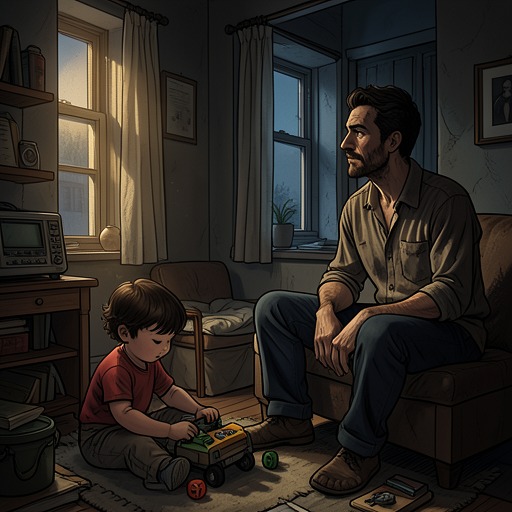
That confinement has a precise domestic scale. Ayyan’s family occupies one room measuring 180 square feet, including an illicit loft. He pictures the life ahead as a repetition of work and return: climbing the steep colonial steps of BDD Chawl, moving through its crowded passages, and seeking refuge at home. The details of the building make poverty a daily environment rather than a single crisis. In the morning he joins people with buckets inching toward chlorine toilets; later he travels to work in a melancholy train, enclosed in a mass of strangers. At home, the family eats together in the small room, with Adi, who is partially deaf, and Oja Mani, whose hope has become attached to the story of her son’s exceptional talent.
Caste, dignity, and social distance
Ayyan understands his position through caste as well as class. Sister Chastity tells him that upper-caste people may call Dalits by degrading names in private even while using the public term Dalit. Her distinction between public language and private contempt confirms the social distance he already knows. Ayyan responds by measuring the advantages of the Brahmins across generations: they have had centuries to build a world of books, English, bridges, and political ideas, while he began in a one-room home as a sweeper’s son. His angry comparison exposes the unfairness of treating the resulting difference in status as proof of innate superiority.
That critique also shapes the disagreement in his own home. When Oja brings home a Ganesha idol, Ayyan rejects the Brahmin-created gods in the stories he associates with the subjugation of his forefathers. He identifies his family as Buddhist and invokes Ambedkar as the figure who showed Dalits how to renounce a religion that treated them cruelly. Oja, by contrast, says that she is Hindu and does not want to pretend otherwise. Their argument reveals that marginality does not produce a single, shared account of identity or belonging. When Oja connects Adi’s hearing impairment with the absence of gods, Ayyan’s response is to stop the argument rather than accept her explanation.
The genius story as an answer to exclusion
The game Ayyan devises for Adi grows from this restricted horizon. He gives his son questions to ask in class, first simple puzzles and then more elaborate prompts. Adi’s questions attract attention because teachers and classmates can read his oddness as evidence of unusual ability rather than merely as a consequence of his age or partial deafness. Adi begins to value that distinction: at school he is treated as extraordinary, not simply as a child described as handicapped. He understands that his mother might oppose the pact and that her opposition could cost him the status he is beginning to receive.
Ayyan sees how easily the appearance of genius can be made to gather around a child who is already bright and wears a hearing aid. He extends the performance by arranging a fictitious news item. When The Times of India publishes a story about Adi reciting the first thousand primes, the family’s local standing shifts. In the morning toilet queue at BDD Chawl, residents gather around the newspaper and ask Ayyan to explain prime numbers; they regard him with affection and respect as the father of a genius. The hearing aid in Adi’s photograph is on his good ear, a small detail Ayyan notices, though nobody else does. For a moment, public recognition reaches into the family’s ordinary surroundings and makes its members visible in a new way.
That attention does not alter the material facts beneath the story. After discussion of an offer of twelve lakhs for a flat, Ayyan argues that the family should sell and leave the chawls so their children can live in proper flats. His wish to move is not a claim that recognition has already improved their lives; it is a demand that the next generation should not have to remain where they are simply because the adults have become accustomed to it. At the Institute, where the Brahmins summon Adi after reading the newspaper, Ayyan watches them gather around the boy. He allows himself to enjoy their attention but has already told Adi that the game must end. The public spectacle can produce a temporary reversal in who is being admired, not a secure escape from the family’s circumstances.
The future imagined for Adi
Once the game ends, Ayyan’s attention returns to the future he fears for his son. He imagines Adi becoming an adolescent, the son of a clerk, expected to abandon his own dreams and prepare for engineering entrance examinations. The route he foresees is narrow and demanding: mastering quantitative ability in the one-room home, competing against boys trained for examinations from early childhood, and then being told that an MBA is the real path to money. He anticipates that, even if Adi succeeds, light-skinned classmates may dismiss him as the beneficiary of Dalit reservation. In Ayyan’s account, educational competition offers a possible route forward while carrying the caste stigma that can discredit the achievement.
The end of the genius story brings back the routine the game had interrupted. Ayyan accepts that this will be life: the queues, the commute, the work, and the return to the cramped home. The ordinary future seems especially bleak because the family has briefly experienced another possibility. Yet Ayyan does not simply persist with the deception until it consumes his son. He ends the performance before he thinks it will make the boy mad, even though he misses its excitement and the warmth it gave their household. His poverty explains the lure of the game, while his decision to stop it shows the limit he places on that lure: temporary glory cannot justify sacrificing Adi to the role that produced it.